In the rarefied world of high-end architecture, the true measure of a home’s soul is no longer found in the magnitude of its budget, but in the quiet provenance of its surfaces. You may find that even the most expansive residences can begin to feel curiously uninspired when they rely on the same predictable finishes seen in every glossy publication. It’s a common frustration for those seeking a home that serves as a personal narrative rather than a showroom floor. By integrating rare materials in luxury interior design, you can cultivate an environment that feels both deeply established and entirely singular.
This guide promises to illuminate how the world’s most elusive substances, from semi-precious stones to ancient fossils, are meticulously curated to create timeless, high-net-worth environments. You’ll discover how to navigate the complexities of ethical sourcing while securing investment-grade finishes that stand as a testament to your personal legacy. We will explore the defining 2026 trends in neo-craftsmanship, radical sustainability, and artistic provenance, providing you with the vision needed to master the art of scarcity and style.
Key Takeaways
- Understand the evolution of the ultra-luxury market, where true distinction is achieved by integrating rare materials in luxury interior design rather than relying on common high-end commodities.
- Learn how to masterfully incorporate semi-precious minerals and petrified wood into your structural design to anchor your home with the permanence of the natural world.
- Discover the narrative power of exotic veneers and reclaimed ancient timbers, which infuse a space with a profound sense of historical depth and uncompromising quality.
- Explore the sensory impact of bespoke textures, including fluid liquid metal finishes and artisanal parchment, to achieve an immersive and highly personalized tactile experience.
- Gain insight into the meticulous global sourcing strategies required to secure elusive materials, ensuring your environment is defined by authentic provenance and enduring investment value.
Defining Rarity in the Age of Ultra-Luxury Interior Design
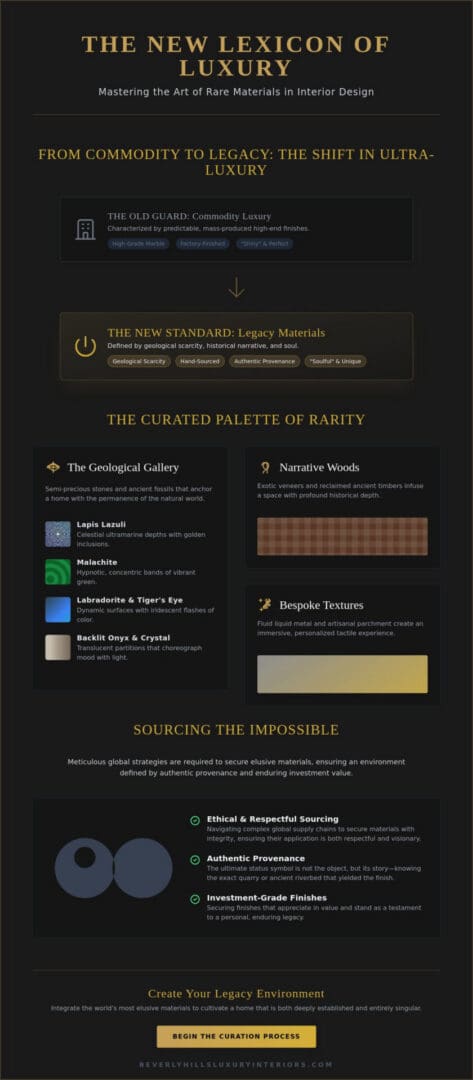
The concept of luxury has undergone a profound transformation. It’s moved beyond the simple display of wealth into a more nuanced appreciation for the elusive and the irreplaceable. While high-grade marble was once the pinnacle of status, it’s increasingly viewed as a beautiful commodity. Today, the discerning eye seeks out rare materials in luxury interior design that possess a distinct botanical or geological scarcity. These are substances that can’t be ordered from a catalogue or synthesized in a laboratory. They carry the weight of time and the primordial thumbprint of the natural world.
Rare materials are defined as those finite resources whose limited availability and distinct physical character ensure they remain exclusive to the most meticulously curated environments. Within the historical context of the Decorative Arts, the use of such materials has always signaled a high level of craftsmanship and cultural literacy. In 2026, the ultimate status symbol isn’t the object itself, but its provenance. Knowing exactly which remote quarry or ancient riverbed yielded a specific slab of stone provides a narrative that transcends mere aesthetics. The designer acts as a steward of these precious resources, ensuring their application is both respectful and visionary.
The Evolution of the Luxury Material Lexicon
The vocabulary of the high-end home has shifted from “shiny” to “soulful.” We’ve moved away from the sterile perfection of factory-finished surfaces toward the tactile irregularity of hand-sourced elements. Natural “imperfections”, such as the erratic veining in a semi-precious stone or the weathered grain of ancient timber, are now celebrated as markers of authenticity. Mass-produced luxury has become the antithesis of the bespoke estate. A home should feel established and permanent, rooted in excellence rather than fleeting trends. It’s about a voice that suggests a world of calm, curated perfection.
Scarcity as a Design Strategy
Using scarcity as a strategy allows for the creation of focal points that are literally one-of-a-kind. When you incorporate a surface that took millions of years to form, you aren’t just decorating a room; you’re anchoring it in a deep historical narrative. This creates a psychological sense of serenity and permanence. It’s the difference between a house that feels new and a home that feels like it has a soul. By prioritizing rare materials in luxury interior design, we ensure that every finish tells a story that cannot be replicated elsewhere. This methodical approach ensures a sense of cohesion and total immersion in the living space.
The Geological Gallery: Semi-Precious Stones and Ancient Fossils
Earth’s deepest layers offer a palette that no synthetic process can replicate. When you move beyond the standard repertoire of marbles, you enter the domain of rare materials in luxury interior design that vibrate with a distinct, primordial energy. Lapis Lazuli, with its celestial ultramarine depths, and Malachite, characterized by its hypnotic, concentric greens, serve as more than mere accents. In a masterfully designed space, these stones become integrated architectural features, forming the luminous surfaces of vanity tops, fireplace surrounds, or entire statement walls that anchor a room in color and history.
The allure of these minerals lies in their ability to manipulate light and perception. Labradorite and Tiger’s Eye introduce a dynamic, shifting quality to an environment through their natural labradorescence and chatoyancy. Their surfaces seem to breathe as the viewer moves, revealing iridescent flashes of peacock blue, metallic green, or golden honey. This creates a sense of living luxury, where the room itself feels responsive and alive. Integrating Rock Crystal or Amethyst directly into the structural framework of cabinetry or lighting takes this concept further, turning raw geological formations into refined, functional art that transcends traditional decor.
Illuminating the Translucent: Onyx and Crystal
Translucency offers a unique opportunity to choreograph the mood of a room through light. By employing advanced backlighting techniques, designers can transform rare colorways of Onyx into glowing, ethereal partitions. The glow softens the stone’s rigid nature, highlighting the intricate veining that has developed over millennia. Sourcing these specific hues requires a discerning eye and a commitment to excellence, ensuring that the final installation feels like a singular, curated masterpiece. If you’re looking to elevate your next project with such exquisite elements, consider exploring the visionary architectural approach that defines our work.
Fossilized Narratives: Ancient Materials in Modern Spaces
There’s a profound gravity in living alongside objects that predate human history. Petrified wood, which represents twenty million years of organic transition, offers a tactile warmth and complexity that traditional stone cannot match. It’s a material that bridges the gap between the botanical and the geological, providing a surface that’s literally frozen in time. Similarly, the use of ammonites and prehistoric remains in wall cladding adds a layer of intellectual depth to a space. The challenge lies in balancing the heavy, ancient history of these fossils with clean, modern architectural lines. It requires a delicate hand to ensure that these brittle, organic treasures are structurally sound while remaining the undisputed focal point of the home’s narrative.
Rare Wood Species and the Narrative of Exotic Veneers
Wood is the living heartbeat of a structure, providing a warmth and organic complexity that stone cannot replicate. In the selection of rare materials in luxury interior design, timber is chosen for its soul, its history, and its visual rhythm. Macassar Ebony and Ziricote stand as the “black gold” of the timber world, prized for their deep, obsidian-like tones and complex grain structures that resemble ink-wash paintings. These species aren’t merely decorative; they are architectural anchors that define the mood of a library, a master suite, or a private gallery. Their rarity ensures that no two installations are ever identical, offering a level of exclusivity that mass-produced alternatives can’t hope to achieve.
Beyond the forests of the present, we often look to the depths of the past. Sourcing “Dead-Head” Cypress or logs reclaimed from the oxygen-free silt of ancient riverbeds adds a layer of geological history to the home. These timbers have been preserved for centuries, developing a density, stability, and silvered patina that young wood lacks. Integrating these rare materials in luxury interior design requires a profound respect for international conservation standards. Navigating CITES regulations and ensuring ethical provenance is a core responsibility of the designer, acting as a steward of resources that are as finite as they are beautiful. This commitment to sustainability ensures that your environment is built on a foundation of integrity and enduring value.
The Art of the Veneer: Patterns Found Nowhere Else
The true value of a rare wood often lies in its figure rather than the species itself. We utilize meticulous book-matching techniques to treat wood grain as a symmetrical masterpiece, creating mirror-image patterns that feel like organic fine art. This process requires a synthesis of traditional craftsmanship and modern precision cutting. Whether it’s the delicate “eyes” of Bird’s Eye Maple or the swirling, cosmic depths of a Walnut Burl, these patterns are the result of nature’s patience and a master creator’s eye. The grain becomes a cartography of time, etched into the very fabric of your bespoke cabinetry.
Rare Woods in Large-Scale Estate Architecture
When applying these materials to Modern Luxury Interior Design in Beverly Hills, the scale of the architecture demands a meticulous approach to stability and climate. Expansive ceiling treatments and floor-to-ceiling library paneling in exotic timbers create an immersive sensory experience, yet they require sophisticated environmental controls. In coastal California, the salt air and humidity fluctuations can be unforgiving to delicate veneers. We ensure that every rare wood installation is supported by advanced HVAC and humidification systems, preserving the integrity of the timber for generations. It’s a methodical, deliberate process that ensures your vision remains as permanent as the materials themselves.
Liquid Metals and Bespoke Finishes: The Architecture of Texture
Texture is the silent language of a room, providing the sensory depth that transforms a house into a sanctuary. While previous chapters focused on the raw offerings of the earth and forest, the curation of rare materials in luxury interior design also encompasses the highly specialized world of bespoke finishes. Cold-cast liquid metals represent a pinnacle of this artistic synthesis. This technology allows us to achieve seamless, sculptural metallic surfaces on complex geometries that were previously impossible to execute with traditional sheet metal. Whether it’s a fluid, undulating feature wall or a series of monolithic columns, these finishes provide a liquid-like sheen that captures and refracts light with a soft, ethereal glow.
A defining trend for 2026 in avant-garde luxury estates involves the integration of metal-infused woods. This innovative process involves forcing liquid metal into the natural pores and grain fissures of rare timber, creating a material that possesses the warmth of wood and the structural brilliance of precious minerals. It’s a bold approach that requires a master’s touch to ensure the two elements coexist in harmony. To achieve this level of depth and luminosity, we also utilize bespoke hand-applied lacquers and resins. These are layered meticulously to create a surface that feels like looking into deep, still water, offering a sense of curated perfection that is entirely unique to your home.
Shagreen and Parchment: The Ultimate Tactile Experience
The return of Shagreen and Parchment signals a revival of the tactile luxury found in the Art Deco era. Sourcing authentic stingray skin, known as shagreen, requires a commitment to excellence and ethical provenance. These skins are used for bespoke furniture inlays, providing a pebbled, jewel-like texture that is both durable and exquisite. Similarly, preparing goat-skin parchment for wall panels is a methodical process that demands significant experience. In the coastal environments of California, these organic materials require precise climate control to maintain their integrity. The result is an immersive environment that feels deeply personal and rooted in a historical lexicon of excellence.
Innovative Metal Finishes in High-End Design
True distinction is often found in the nuances of a finish. We utilize rare patinas on bronze and copper to create “living” finishes that evolve gracefully over time, reflecting the natural life of the home. Integrating precious metal leaf, such as gold or platinum, into architectural plasterwork adds a layer of quiet confidence and timelessness. The execution of these one-of-a-kind textures relies entirely on the role of specialized artisans who treat every surface as a canvas. If you wish to explore how these artisanal textures can redefine your private estate, we invite you to consult with our visionary design team about your next project.
- Seamless Fluidity: Liquid metals allow for metallic finishes on curved or intricate architectural forms.
- Artisanal Depth: Hand-applied lacquers create a sense of three-dimensional luminosity.
- Historical Resonance: Shagreen and parchment offer a connection to the grand traditions of the early 20th century.
- Living Patinas: Metals that age with the structure, adding a sense of permanence and legacy.
Sourcing the Impossible: The Beverly Hills Luxury Interiors Approach
Sourcing the impossible requires more than a digital catalog; it demands a global network built over decades of uncompromising pursuit. Kenneth, widely recognized as “The Billion Dollar Designer,” leverages over 25 years of specialized global sourcing to locate the world’s most elusive substances. This isn’t a passive procurement process. It’s a “boots on the ground” commitment that involves visiting remote quarries in Italy or specialized timber reserves to hand-select the exact specimens that will define a residence. By prioritizing this direct oversight, we ensure that the rare materials in luxury interior design projects we undertake possess both the aesthetic brilliance and the authentic provenance our clients expect.
Integrating these extraordinary elements into a cohesive, timeless aesthetic is the hallmark of our firm’s approach. We view the designer not merely as a decorator, but as a visionary guide and a steward of a grand vision. This personality is bold and innovative, yet it remains deeply respectful of tradition and heritage. Every material chosen is part of a larger narrative arc, moving at a pace that suggests luxury; never hurried, always thorough, and entirely intentional. Our commitment to architectural excellence through material innovation ensures that every space we create feels established, permanent, and deeply rooted in excellence.
The Bespoke Consultation: From Vision to Materiality
Every project begins with a vision of legacy. The bespoke home design consultation is the vital first step in translating a client’s personal narrative into physical materiality. This is a deeply collaborative journey where the designer, the artisan, and the homeowner work in concert. We tailor material selections to the client’s personal legacy and lifestyle, ensuring the results are as soulful as they are sophisticated. It’s a methodical transition from a grand, sweeping vision down to the tactile reality of the finest elements, ensuring a sense of cohesion and total immersion.
Ensuring Longevity in Ultra-Luxury Environments
Integrating rare materials in luxury interior design requires significant architectural and engineering expertise. When you introduce semi-precious stones that weigh several tons or delicate ancient veneers, the structural framework of the home must be meticulously designed to support them. Our firm prioritizes the technical engineering required to anchor these heavy stones and protect delicate surfaces from environmental stressors. To safeguard these investments, we often integrate smart home solutions from PREMIERE SYSTEMS DESIGN to manage the precise environmental conditions required for longevity. Expert architectural planning protects your rare material investments, ensuring their beauty remains a permanent fixture of your estate. We believe that the deliberate stewardship of the world’s most finite resources is the only way to cultivate a home of permanent, investment-grade value.
Cultivating a Legacy of Permanent Beauty
The mastery of your environment begins with the understanding that true luxury is found in the irreplaceable. By integrating rare materials in luxury interior design, you transcend the predictable and anchor your home in a narrative of geological history, botanical rarity, and artisanal excellence. Whether you’re drawn to the luminous depths of semi-precious stones or the tactile warmth of ancient, reclaimed timbers, these choices represent a commitment to a lifestyle of curated perfection. It’s about more than aesthetic appeal; it’s about the stewardship of a vision that will endure for generations.
Led by Kenneth, “The Billion Dollar Designer,” our firm brings over 25 years of experience in ultra-luxury sourcing and bespoke interior architecture to every project. We specialize in navigating the complexities of global procurement to secure the impossible, ensuring your estate reflects a singular, investment-grade identity. Your journey toward a home of quiet confidence and timelessness starts with a single, intentional step. Transform your estate with the world’s most exclusive materials and schedule a Bespoke Home Design Consultation with Kenneth today. We look forward to realizing your vision with uncompromising quality and refinement.
Frequently Asked Questions
What makes a material “rare” in luxury interior design?
A material is considered rare when its availability is constrained by geological scarcity, botanical limitations, or the extreme difficulty of its extraction and preservation. This includes substances like semi-precious minerals that take millennia to form or ancient riverbed timbers that are no longer actively growing. Rarity ensures that these elements remain exclusive to the most meticulously curated environments, far removed from the accessibility of mass-produced commodities.
Are rare materials like malachite or lapis lazuli durable enough for daily use?
Semi-precious stones like malachite and lapis lazuli are entirely suitable for architectural features, though they require a more delicate hand than standard granite or quartzite. These materials are often integrated into low-impact surfaces such as statement walls, vanity fronts, or bespoke furniture inlays where their vibrant energy can be appreciated without excessive wear. When applied correctly by master artisans, they offer a permanent beauty that withstands the rhythms of a refined lifestyle.
How do you ensure the ethical sourcing of rare exotic woods?
Ethical sourcing of rare timbers is achieved through strict adherence to international regulations and a preference for reclaimed or salvaged materials. We often seek out ancient logs preserved in riverbeds or “Dead-Head” Cypress that’s been submerged for centuries. This ensures that the use of rare materials in luxury interior design remains a practice of responsible stewardship, preserving the natural world while honoring its most exquisite botanical offerings.
Why is provenance so important when selecting materials for a high-end estate?
Provenance is the ultimate status symbol because it provides a documented narrative of a material’s origin, journey, and historical significance. Knowing the specific remote quarry or the exact ancient forest from which a surface was sourced adds a layer of intellectual depth to the home. It transforms a physical structure into a personal legacy, ensuring that every element within the residence carries a sense of authentic provenance and uncompromising quality.
Can rare materials be integrated into a modern, minimalist design?
Rare materials are exceptionally well-suited for modern, minimalist environments where they act as singular, powerful focal points. The contrast between clean architectural lines and the complex, organic texture of a petrified wood slab or a liquid metal finish creates a sophisticated visual tension. In these spaces, a single well-placed element of rarity speaks more eloquently than a room filled with standard high-end finishes, maintaining a sense of serene, curated perfection.
What are the most popular rare materials for 2026 luxury interiors?
The defining 2026 trends focus on hyper-tactile, sensory materials such as petrified wood, fluid liquid metallic finishes, and translucent onyx with advanced backlighting. We’re also seeing a move toward metal-infused woods and ancient fossils integrated into structural wall cladding. These materials prioritize a connection to the natural world and the master creator’s touch, offering a soulful alternative to the predictable aesthetics of the past decade.
How does the use of rare materials impact the overall cost of an interior design project?
The use of rare materials in luxury interior design naturally increases the investment required for a project. This is due to the scarcity of the resources and the specialized craftsmanship needed for their installation. These materials often demand advanced architectural engineering to support their weight or delicate nature. This investment results in a home of permanent, investment-grade value that stands as a testament to excellence rather than a reflection of fleeting trends.
Do rare materials require special maintenance or climate control?
Rare organic materials and delicate veneers often require sophisticated climate control systems to maintain their stability and appearance over time. In environments like coastal California, precise humidification and HVAC management are essential to protect ancient timbers or hand-applied parchments from salt air and moisture fluctuations. This methodical approach to maintenance ensures that your investment remains as pristine and evocative as the day it was first installed.